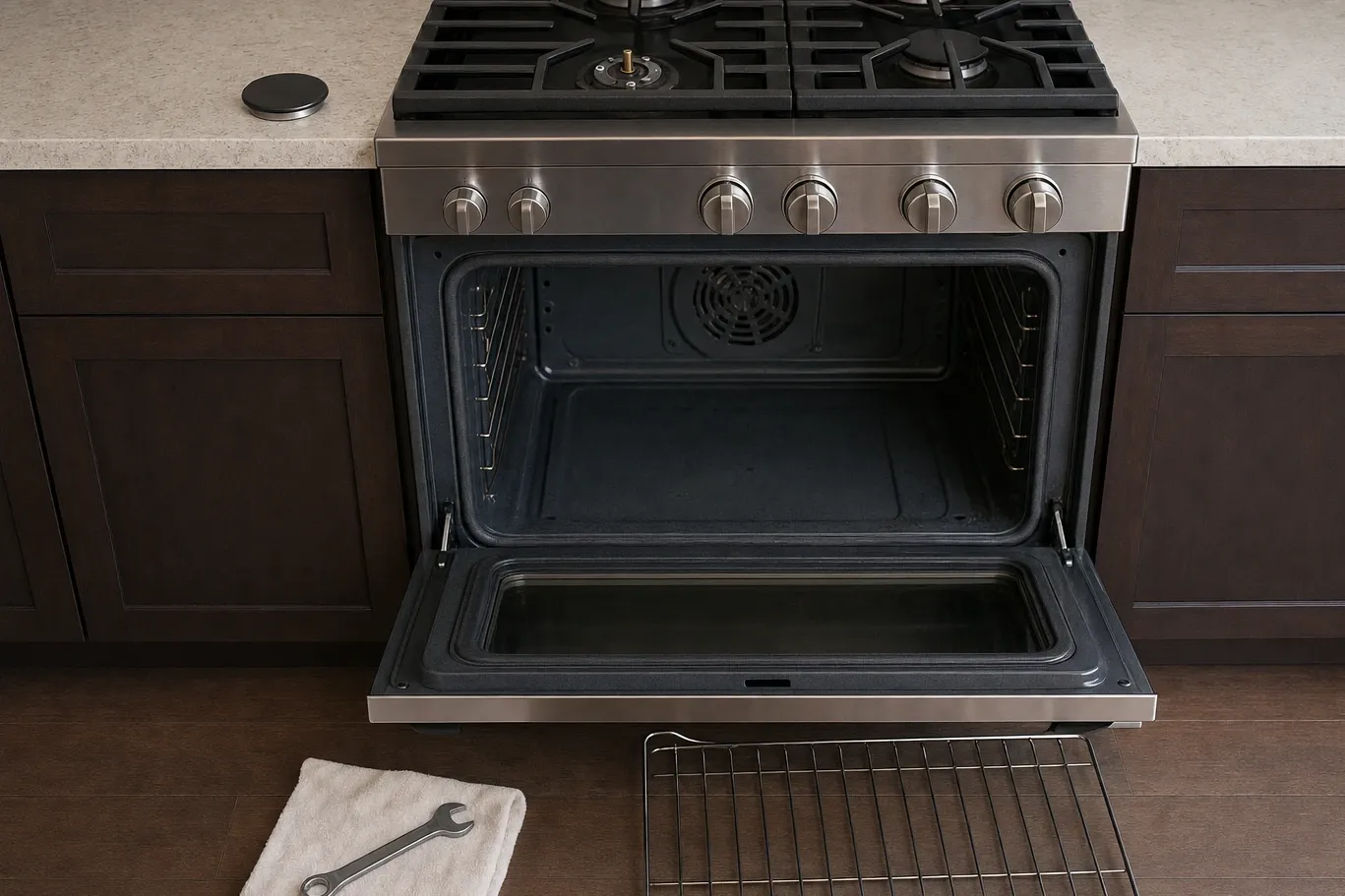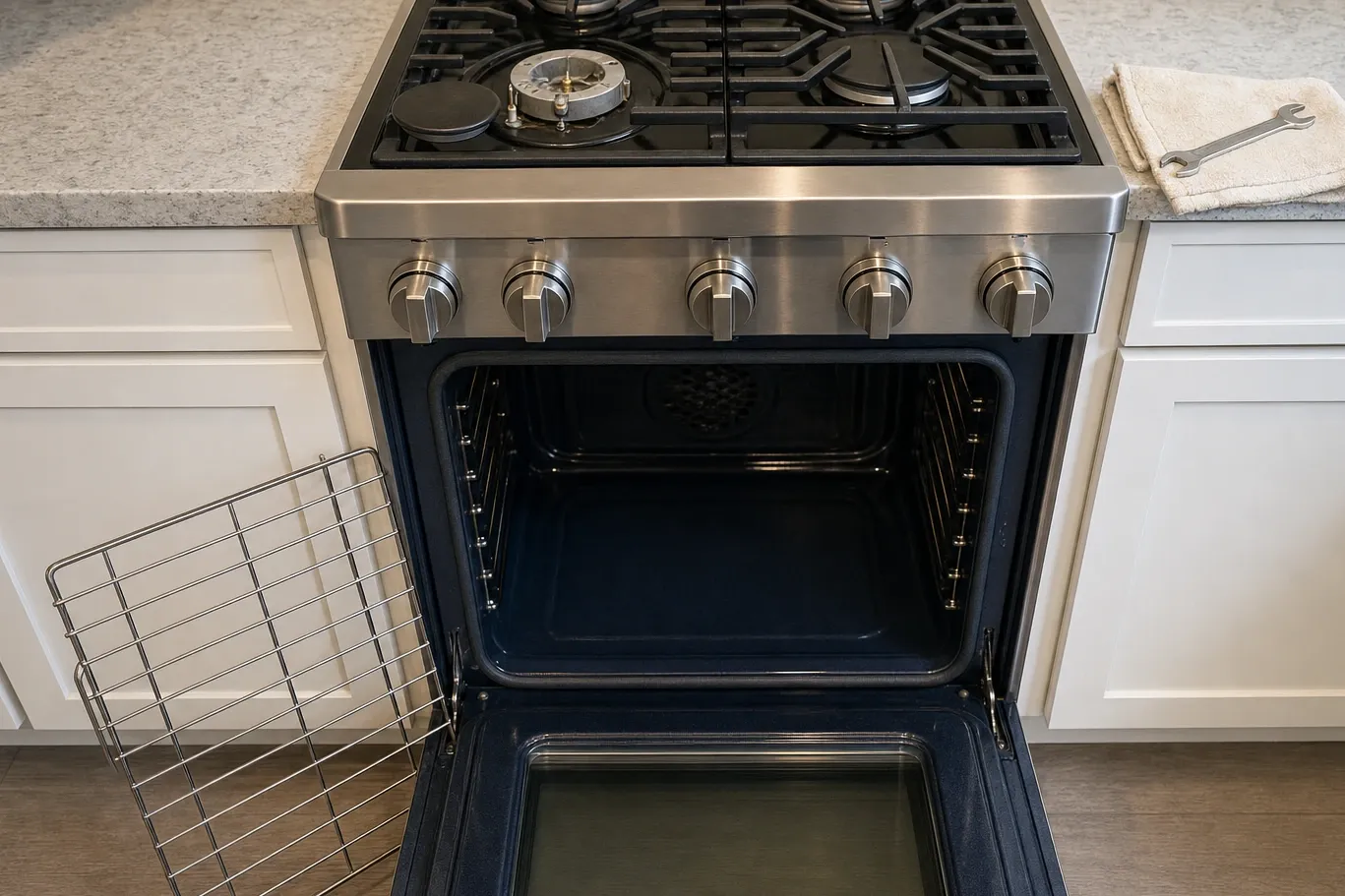
Wolf Range Repair
Behind South Mountain: Getting a Wolf Range Fixed on the First Visit in Ahwatukee
In Ahwatukee, behind 16,000 acres of South Mountain Park, a wrong part means a second trip around the mountain — so Wolf range faults are mapped to a likely part over the phone, and that part travels with the technician on the first visit.
Written by
Thandiwe Mokoena
Cooking-appliance technician — convection and airflow · 16 years in the trade
South Mountain Park and Preserve covers more than 16,000 acres and is the largest municipal park in the United States. Ahwatukee sits on the far side of it — roughly 35 to 36 square miles of foothill subdivisions, boxed in by the preserve to the northwest and the Gila River Indian Community to the south, with road access historically only from the east at Interstate 10. The nickname locals use, the world’s largest cul-de-sac, is not affectionate by accident. The 22-mile Loop 202 South Mountain Freeway opened in 2019 and gave the village its first western gateway.
For most trades that geography is a commute. For appliance repair it is a method problem. A part that is wrong or missing is not a ten-minute detour to a supplier here; it is a trip back around or over the mountain and a second appointment.
So the work in Ahwatukee starts before anyone is in a van.
What people here assume is wrong with it
Two assumptions, both reasonable, both costly on this side of the mountain. The first is that a Wolf range with working burners and a dead oven has reached the end of its life. It almost never has — those are separate systems that happen to share a cabinet, and the oven side failing tells you something quite specific.
The second is that describing the symptom on the phone is a formality, and the technician will work it out on arrival. In Arcadia or North Central Phoenix that assumption costs you an hour. In Ahwatukee it costs you a week, because the diagnosis and the part cannot be reunited without another drive around South Mountain.
What is actually happening
Wolf parts are model-specific at the level that matters. Spark modules, igniters, gas valves, oven sensors, control boards and convection motors are not interchangeable across the range of models sitting in these kitchens, and the correct one is determined by the model and serial on the rating plate, not by the appearance of the appliance.
That means the van either carries the right part or it does not, and there is no recovering from the second case within the same visit. Elsewhere in the city a technician can guess broadly and correct cheaply. Behind a 16,000-acre preserve, guessing broadly is how a one-visit fault becomes a two-visit fault.
The answer is not to guess better. It is to convert the symptom into a likely part before the appointment is confirmed, and to carry that part along with the two most plausible alternatives.
The evidence, in the order we look at it
This is why the phone call is long, and it follows a sequence.
A burner that sparks endlessly and never lights, on every burner at once, points at the spark module or its earth. The same symptom on one burner alone points at that electrode, its gap, or a port blocked by boil-over — a completely different part and a much smaller bill.
No usable simmer, where the low setting either roars or drops out, is a burner valve, an orifice or an air adjustment rather than an ignition fault. A griddle that scorches at one end and barely warms at the other is an element or a thermostat on that section, and which one depends on whether the cold end is cold everywhere or only at the edge.
Burners working normally with the oven dead after a storm outage is the classic monsoon call, and it is usually the oven control or a thermal protection device rather than anything mechanical. That is the one we most want to know about in advance, because the board is the part least likely to be on general stock.
Then the rating plate. Look along the door frame with the oven open and behind the toe-kick panel; photograph the whole plate rather than typing out the number, because a single transposed character orders the wrong item.
The fix that holds
With the symptom mapped and the plate photographed, the repair is ordinary work done once. Igniter or spark module replacement runs $170 to $450. A burner valve or orifice service is $240 to $600. Oven thermostat or sensor calibration is $200 to $420, a convection fan or motor $280 to $700, a control board or touch panel $470 to $890, and door hinge, glass or seal work $280 to $750.
Two honest caveats. Not every fault can be predicted from a description — some genuinely need a meter on the appliance before the part is known, and pretending otherwise would just be selling optimism. And a part carried on spec is a part carried, not a part you are charged for; nothing gets fitted before you have the figure and have agreed to it.
Where to stop and call
Stop at the point where gas or a live spark circuit is involved. Clearing a blocked burner port with the range off is homeowner work. Opening a gas valve, testing a spark module, or dismantling an oven control is not, and in a village where the follow-up visit is a mountain away, an improvised repair that half-works is the worst outcome available.
Call with the model and serial photographed, the symptom described as precisely as you can, and any recent outage mentioned. That handful of information is what turns the drive around South Mountain into a single trip. The service call is a flat $89, covering the drive and the whole diagnosis. Wolf Repair Experts of Phoenix works Ahwatukee, Arcadia, Biltmore and North Central Phoenix on (602) 560-4488.
Follow-up questions
- Why so many questions on the phone before an Ahwatukee visit?
- Because a wrong part out here is a second trip around a 16,000-acre preserve, not a quick detour to a supplier. Spark modules, igniters, valves, sensors and boards are model-specific, so the symptom gets mapped to a likely part and that part travels with the technician. Ten minutes of questions and a photograph of the rating plate routinely turn two appointments into one.
- The oven died after a monsoon outage but the burners still work. What is that?
- Two systems sharing one cabinet. The burners are gas with their own ignition and ride out a power event; the oven side depends on its control and protection devices, which are exactly what an outage tends to take out. It is a common foothills call after a storm, and it normally needs the oven control rather than a new appliance.
- Where do I find the model and serial number on a Wolf range?
- Look along the frame with the oven door open, and behind the toe-kick panel at the base. Photograph the whole plate rather than typing the number out, because one transposed character orders the wrong item — and here that is a wasted trip rather than a wasted hour. Send the photograph when you book and the right component rides out with the van.